Montana's 15 bat species
Montana has 15 confirmed bat species, all in the family Vespertilionidae. FWP notes they range from about 5 grams to about 25 grams, eat insects, and provide pest control that FWP values at roughly $680 million a year for agriculture.
| Common name | Scientific name |
|---|---|
| Little Brown Myotis | Myotis lucifugus |
| Big Brown Bat | Eptesicus fuscus |
| Yuma Myotis | Myotis yumanensis |
| Long-legged Myotis | Myotis volans |
| Long-eared Myotis | Myotis evotis |
| Fringed Myotis | Myotis thysanodes |
| Northern Myotis | Myotis septentrionalis |
| California Myotis | Myotis californicus |
| Western Small-footed Myotis | Myotis ciliolabrum |
| Silver-haired Bat | Lasionycteris noctivagans |
| Hoary Bat | Lasiurus cinereus |
| Eastern Red Bat | Lasiurus borealis |
| Townsend's Big-eared Bat | Corynorhinus townsendii |
| Pallid Bat | Antrozous pallidus |
| Spotted Bat | Euderma maculatum |
Species list: Montana Natural Heritage Program, Bats of Montana: Identification and Natural History (2018).
The two bats in Montana buildings
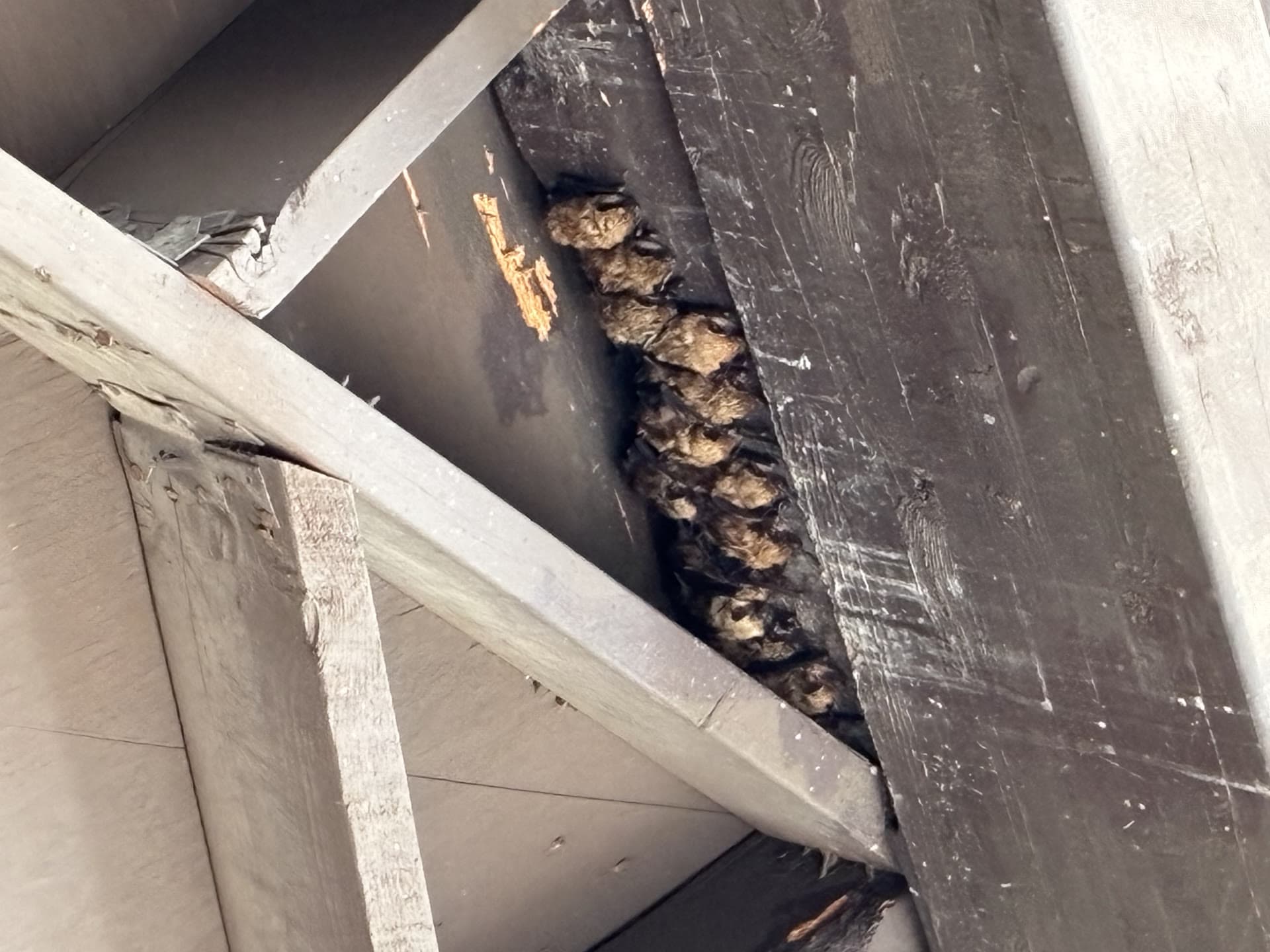
Little brown myotis. The Montana Field Guide calls it the most common bat in the state. It lives in Montana year-round, roosts in summer in attics, barns, bridges, and bat houses, and known Montana maternity roosts are primarily in buildings. Colonies can exceed 1,000 bats, and individuals can live more than 30 years. It is a Montana Species of Concern (state rank S2S3) because white-nose syndrome has caused steep declines in some areas, and it hibernates in caves and mines.
Big brown bat. Found statewide and ranked S4 (apparently secure), it readily uses man-made structures, forming maternity colonies in buildings, bridges, and snags. Adults weigh about 14–25 grams. It hibernates from roughly late October to March or April and is one of the bats that may overwinter in buildings, with occasional winter activity.
Maternity season & hibernation
Female bats gather in maternity colonies in late spring. Big brown bat pups are typically born in mid-to-late June and are flying by mid-July; little brown myotis give birth to a single pup in late June or July.
That's why FWP says never to exclude bats from May through August — pups that can't fly would be trapped inside. FWP's white-nose syndrome management plan uses April 1–August 31 as the default maternity period. By September the young are flying, and fall is the preferred time to exclude.
Apr–Aug
Maternity season — no exclusion
FWP: never exclude bats May through August, when flightless young may be inside. FWP's exclusion guidance treats April 1–August 31 as the default maternity period.
Sep–Oct
Best exclusion window
By September the young can fly. Fall, before bats settle in to hibernate, is FWP's preferred time to exclude.
Nov–Mar
Hibernation — inspect & plan
Many bats winter in caves and mines, but big brown bats sometimes hibernate in buildings. Don't exclude bats hibernating in a structure.
White-nose syndrome in Montana
White-nose syndrome is a fungal disease that affects bats during hibernation. Montana FWP has done surveillance since 2012. The fungus (Pseudogymnoascus destructans) was first detected in Montana in 2020, and in April 2021 FWP announced the disease had been confirmed in bats in eastern Montana.
In September 2025 the fungus was detected on bats at Libby Dam in Lincoln County — the first detection in Montana west of the Continental Divide. FWP says 7 of Montana's 15 bat species are susceptible.
What it means for homeowners: bats that survive are more valuable than ever. Humane exclusion, done at the right time, protects both your home and a population under pressure.
Bats & rabies
Montana DPHHS lists bats as a high-risk species for rabies, and rabies is a reportable disease in Montana. Bat bites can be tiny and easy to miss. In 2026, local reporting noted 13 rabies-positive bats statewide by September and two positive bats in the Missoula area in October.
- Never touch a bat with bare hands.
- If a person may have had contact — including waking up with a bat in the room, or a bat found near a child or impaired person — don't release it. Call your local health department.
- If a bat must be held for testing, DPHHS guidance is to refrigerate it, not freeze it.
- Montana's Veterinary Diagnostic Laboratory in Bozeman performs rabies testing; health departments coordinate submissions.
Local contacts: Billings, Missoula, Bozeman, Great Falls, Helena, Kalispell. Statewide, DPHHS keeps a list of every county health department.
Legal, humane exclusion
FWP describes Montana's bats as state-protected nongame wildlife (see Montana Code Annotated Title 87, chapter 5) and recommends humane exclusion for bats in buildings:
- Timing: never May–August; fall is best, once young can fly.
- Find the exits: watch the building at dusk to see where bats leave.
- One-way devices: netting should hang about 2 feet below and beyond the sides of the opening. FWP's exclusion guidance calls for leaving devices up at least 5 nights, including 3 nights above 50°F with wind under 10 mph.
- Seal: close crevices — FWP's plan cites gaps of 1/4 inch or more; MSU Extension notes bats can use 3/8-inch slits.
- Winter: don't exclude bats that are hibernating in the structure.
- No poisons, no trapping: no toxicants are registered for bats in Montana, and FWP does not recommend trapping.
Giving the colony a bat house nearby can provide an alternate roost. Ready to get it done right? See our bat removal & exclusion service.